On May 1, 2026, the European Union fully enforced its Import Control System 2 (ICS2) for all modes of transport – sea, air, rail, and road. The new system requires carriers, freight forwarders, and shippers to submit detailed advance cargo data. Non‑compliance leads to holds, fines, or even return of goods. This article explains what ICS2 is, what data you must provide, common pitfalls, and a step‑by‑step compliance checklist.
1. What Is ICS2?
ICS2 is the EU’s second‑generation customs risk management system. It collects electronic entry summary declarations (ENS) before goods arrive in the EU. The goal is to improve supply chain security by identifying high‑risk consignments earlier. Unlike the previous system, ICS2 applies to all modes (sea, air, rail, road) and covers all goods, including postal and express shipments.
Key dates:
-
March 2024: Air freight (phase 1)
-
December 2024: Air express and postal (phase 2)
-
May 1, 2026: Sea, road, rail – full enforcement
2. Scope: Who Must File, and Which Shipments?
Who must file
-
The carrier (shipping line, airline, railway company, trucking company) is legally responsible.
-
However, carriers rely on freight forwarders and shippers to provide accurate data.
-
In practice, the party issuing the transport document (forwarder or NVOCC) files the ENS.
Which shipments
-
All goods entering the EU customs territory (including the 27 member states, plus Norway, Switzerland, Northern Ireland for certain movements).
-
Exceptions: goods already released for free circulation, certain military items, and low‑value documents (not goods).
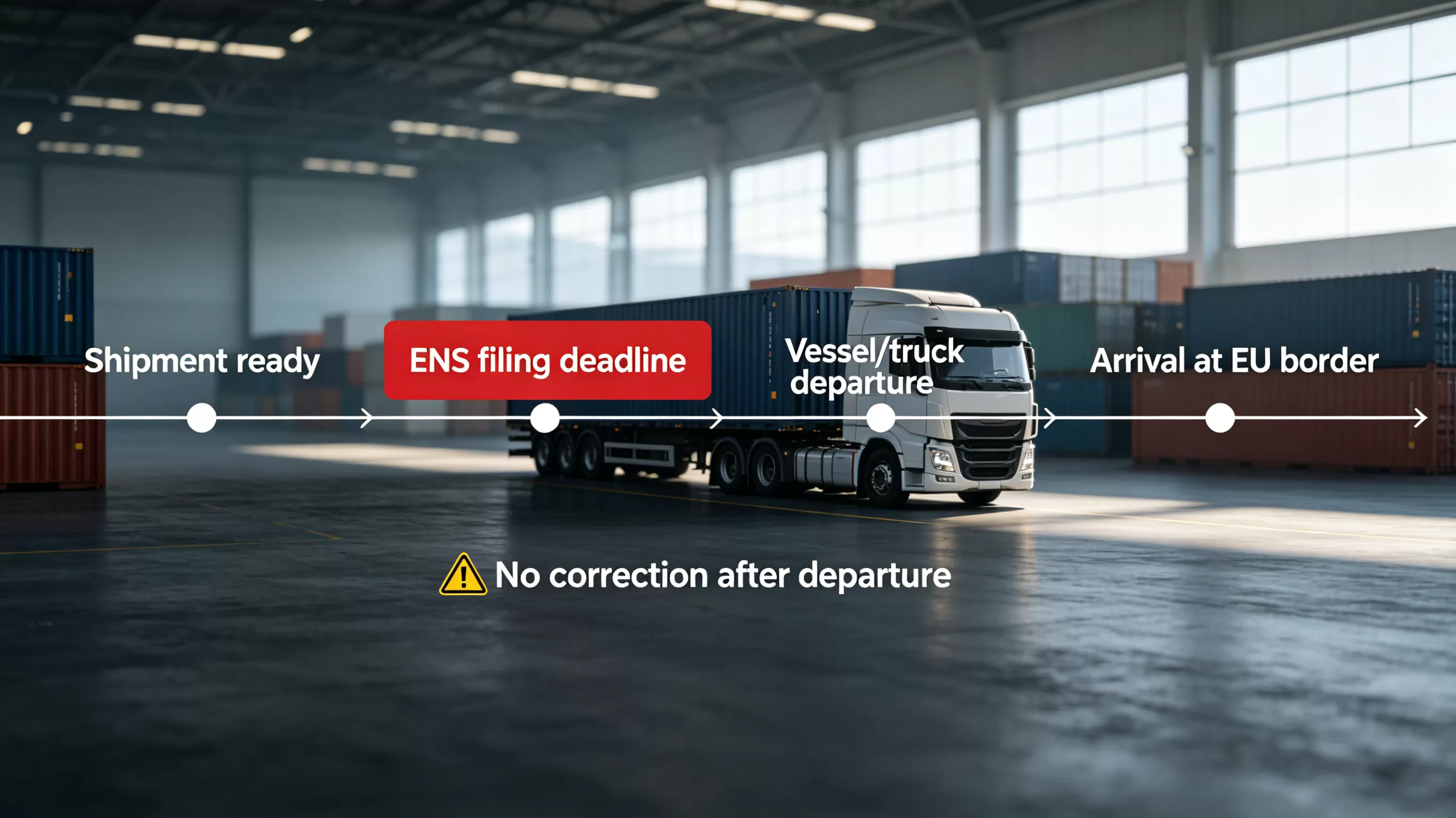
Time window
| Mode |
Filing deadline before arrival |
| Sea (container) |
24 hours before loading at foreign port |
| Short‑sea (ferry) |
2 hours before arrival |
| Air (general cargo) |
4 hours before departure |
| Air (express) |
30 minutes before departure |
| Rail & road |
1 hour before arrival at EU border |
3. Core Data Requirements
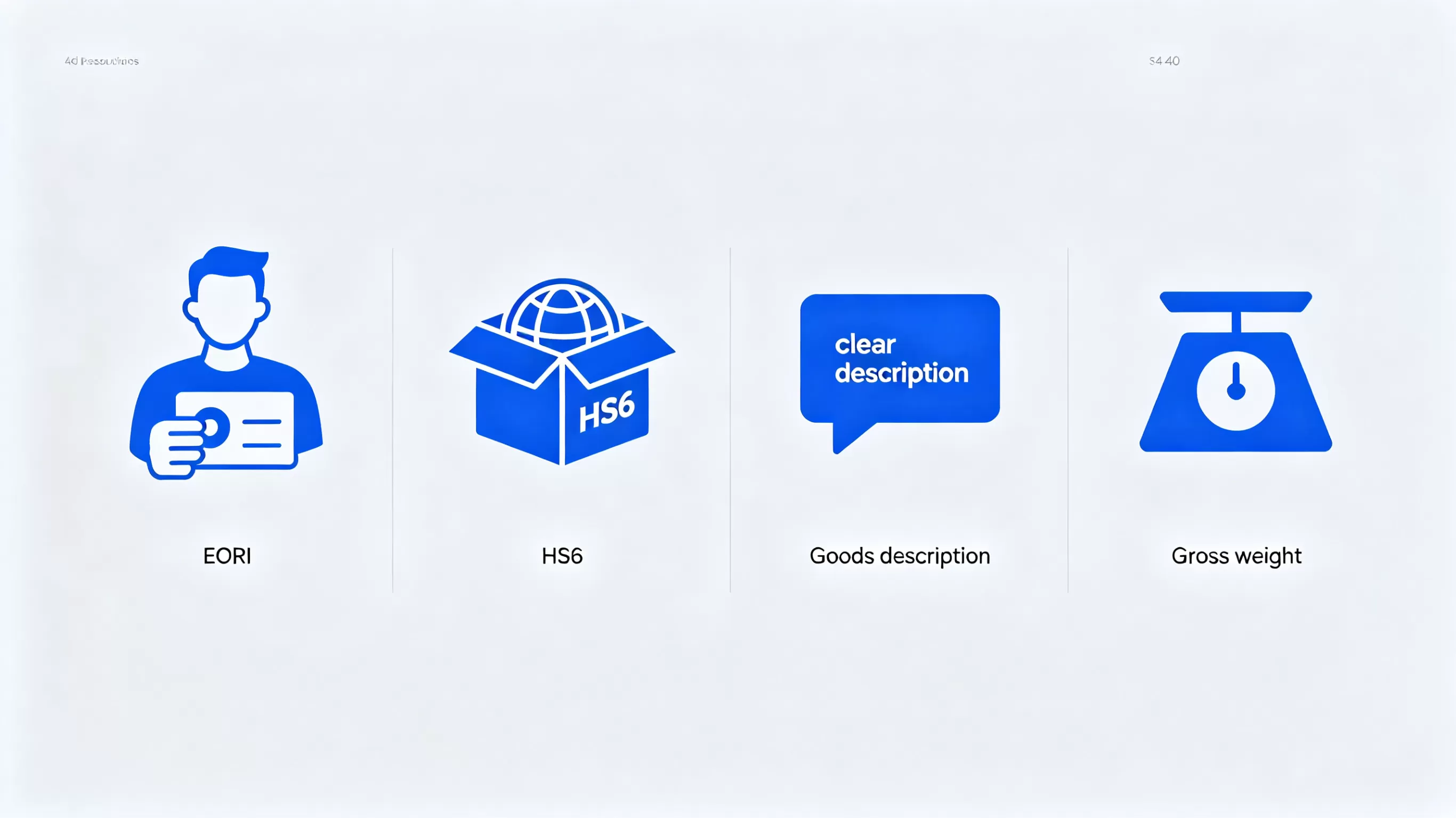
The ENS must contain the following data elements (key ones for shippers/forwarders):
| Data field |
Requirement |
| Consignor (sender) |
Full name, address, EORI number (if available) |
| Consignee (receiver) |
Full name, address, EORI number (mandatory) |
| Goods description |
Clear, precise text – no generic terms like “parts” or “chemicals” |
| HS code |
6‑digit Harmonized System code |
| Gross weight |
In kilograms |
| Number of packages |
Total pieces |
| Transport mode & route |
Vessel/flight/train identifier, port/airport codes |
| Container number (for sea) |
Unique container ID |
Most critical: The EORI number of the consignee (Economic Operators Registration and Identification). Without a valid EORI, the declaration will be rejected. Also, the goods description must be specific – “electronic device” is acceptable, but “accessories” is not.
4. Consequences of Non‑Compliance
If the ENS is missing, incomplete, or inaccurate:
-
Customs hold – The goods will not be allowed to enter the EU.
-
Fines – EU member states can impose penalties (typically €1,000–€5,000 per violation).
-
Return or destruction – If the carrier cannot correct the declaration, the goods may be sent back at the shipper’s cost.
-
Increased inspections – Repeated errors can lead to a higher risk rating, meaning more physical checks for future shipments.
Real‑life example: In May 2026, a Chinese electronics exporter used “electronic parts” as the goods description for a mixed consignment. The ENS was rejected. The forwarder had to stop the shipment, pay €2,000 to file a corrected declaration, and the goods arrived 12 days late.
5. Practical Checklist for Shippers and Forwarders
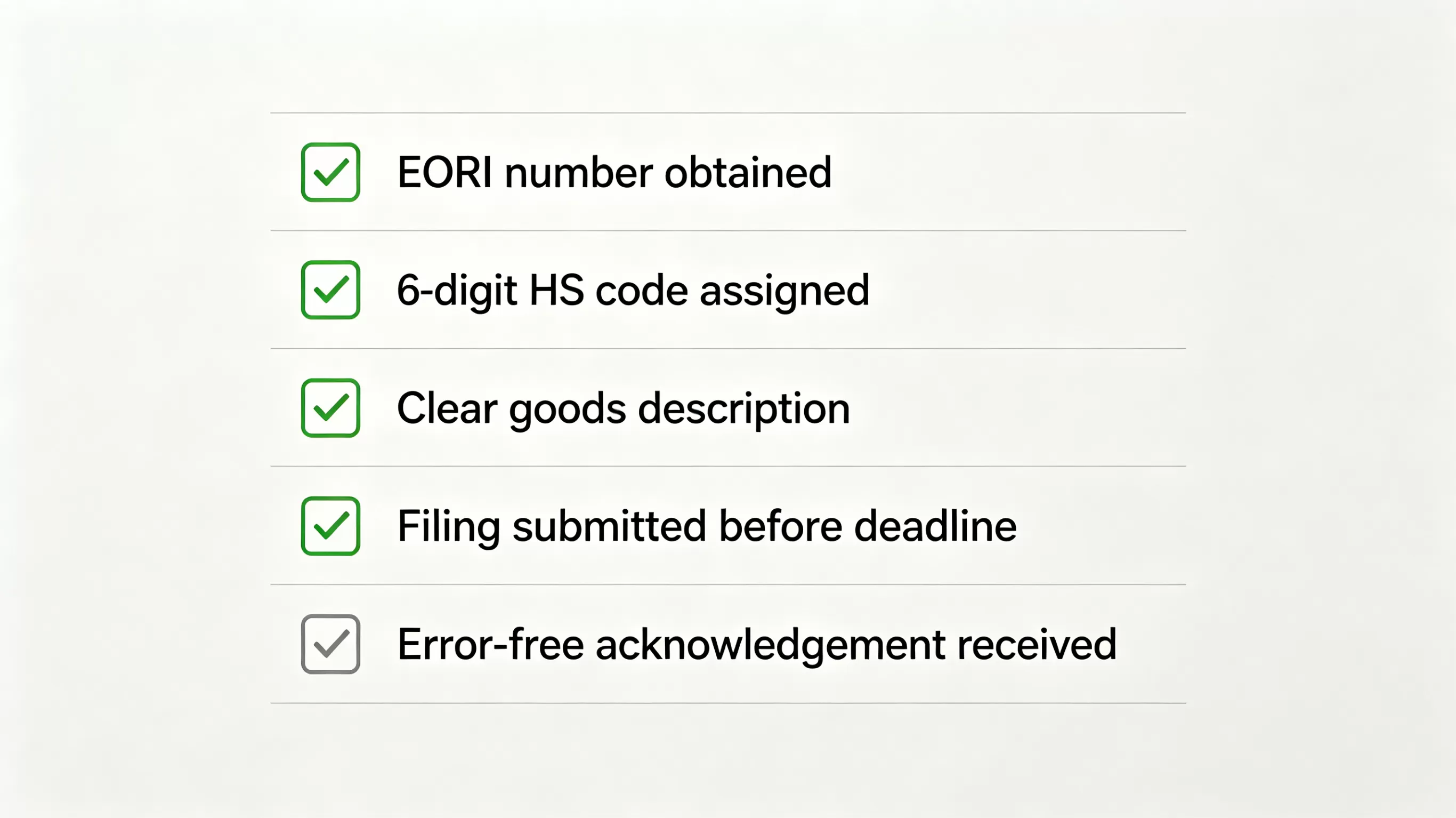
Use this checklist before every shipment to ensure ICS2 compliance:
✅ Obtain consignee’s EORI number – Always ask your buyer for their valid EU EORI. Without it, do not ship.
✅ Write precise goods descriptions – “Ceramic kitchen tiles, glazed, 30x30cm” instead of “tiles”.
✅ Assign correct 6‑digit HS codes – Use your country’s official tariff database.
✅ Check EORI validity – You can verify online via the EU’s EORI validation portal.
✅ Submit data early – Do not wait until the last hour. Submit at least 48 hours before the carrier’s filing deadline.
✅ Keep a master data file – Store EORI, HS codes, and product descriptions for repeat customers.
For freight forwarders:
-
Implement a pre‑validation step in your booking system.
-
Train customer service teams to refuse incomplete bookings.
-
Use ICS2‑compliant software that checks data formats.
6. Glovoyce Practical Recommendations
ICS2 is not a one‑time adjustment – it requires a permanent change in how shippers prepare export documentation. We recommend:
-
Centralize product master data – Create an internal database with SKU, HS code (6 digits), and a standardised description. Use this for every EU shipment.
-
Automate EORI collection – Add an EORI field to your commercial invoice template. Reject orders where the buyer does not provide a valid EORI.
-
Partner with ICS2‑ready forwarders – Choose logistics providers that offer ENS pre‑validation and send you error reports in real time. Glovoyce’s system flags missing data before you submit.
-
Train your logistics team – Ensure everyone knows the consequences of vague descriptions or missing HS codes. Run quarterly ICS2 compliance refreshers.
-
Plan extra lead time – For the first 2–3 months after full enforcement (May–July 2026), submit ENS at least 4 days before the cut‑off. This allows time to correct errors.
7. Common Myths About ICS2
-
Myth 1: “Only carriers are responsible.”
Fact: Carriers will pass penalties to shippers or forwarders who provided wrong data. You are ultimately liable for your product information.
-
Myth 2: “Low‑value gifts are exempt.”
Fact: All goods, regardless of value, must have an ENS. Only non‑commercial correspondence is exempt.
-
Myth 3: “If we use DDP, we don’t need the buyer’s EORI.”
Fact: The consignee remains the EU importer. You still need the buyer’s EORI; otherwise, the carrier cannot file the ENS.
Summary
The EU’s ICS2 is a major shift toward real‑time, data‑driven supply chain supervision. For exporters, success depends on accurate product descriptions, correct 6‑digit HS codes, and valid consignee EORI numbers. The cost of non‑compliance – holds, fines, and returns – far outweighs the effort to implement a robust pre‑shipment data check.
Glovoyce can help – our compliance team offers ICS2 pre‑validation services, automated data templates, and real‑time filing status alerts. Contact us to ensure your EU shipments flow without interruption.